

Booking Strategy Decision Tool
Answer these questions to see if a professional travel agent is worth it for your specific trip.
Our Recommendation:
Key Takeaways
- Travel agents provide security and expertise but may charge service fees.
- You might lose some flexibility in "off-the-beaten-path" itinerary customization.
- Agents often have access to exclusive packages that aren't public online.
- The biggest risk is relying on an agent who is biased toward specific resorts for commissions.
The Cost Question: Who Actually Pays?
One of the biggest worries is that a travel agent will make your trip more expensive. Here is the truth: in many cases, they don't. Travel Agents is a professional service that organizes travel arrangements for clients, often earning commissions from suppliers. Most hotels, cruise lines, and tour operators pay the agent a commission after you pay for the trip. This means the price you see is often the same whether you book it yourself or through a pro.
However, some high-end consultants charge a "planning fee" or a flat service fee. If you're asking them to spend ten hours researching the perfect boutique villa in Bali, they'll likely charge for their time. The downside here is a direct hit to your wallet before you've even left home. But if you're booking a standard package, that fee is rare. The real cost risk comes from "preferred partners." An agent might push you toward a specific resort not because it's the best for you, but because that resort pays the highest commission.
Loss of Control and Flexibility
When you book your own trip, you have a digital paper trail of every single confirmation. When you use an agent, you're essentially outsourcing your logistics. For some, this is a relief; for others, it's a nightmare. If you're a "control freak" who loves picking the exact room number or the specific flight connection, an agent might feel like a barrier.
There is also the issue of speed. If you see a flash deal on a flight to Mexico at 2 AM, you can book it in thirty seconds. If you have an agent, you have to wait for business hours, send an email, and wait for them to confirm. By the time they get back to you, that specific room at the all-inclusive resort might be gone. You trade the agility of a smartphone for the expertise of a human, and for some travelers, that lag is a dealbreaker.
| Feature | DIY Booking | Travel Agent |
|---|---|---|
| Price | Direct, potentially cheaper for budget finds | Competitive, often includes bundled perks |
| Time Spent | High (hours of research) | Low (agent does the heavy lifting) |
| Support | You call the airline/hotel yourself | Agent handles the disputes/changes |
| Customization | Total control | Guided based on agent's network |
The Bias Trap in All Inclusive Holidays
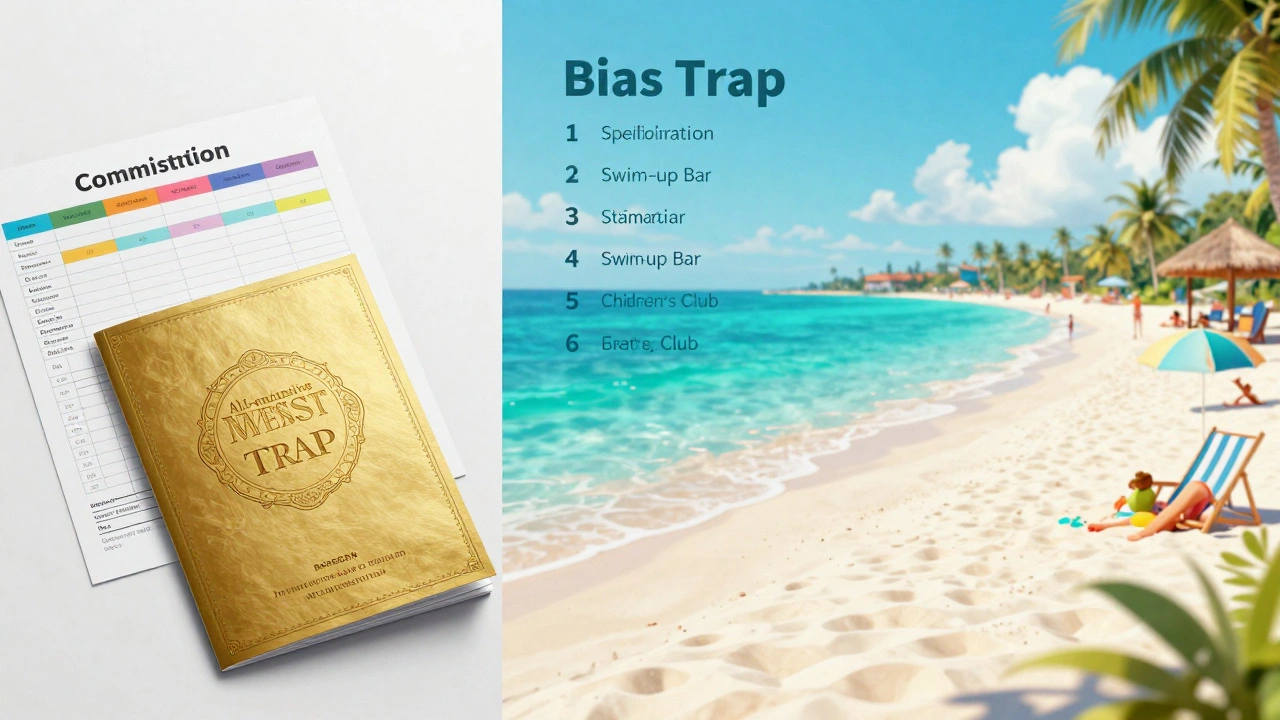
If you are planning All Inclusive Holidays is a vacation package where the cost of lodging, meals, drinks, and activities are bundled into a single upfront price., the agent's influence is amplified. All-inclusive resorts are massive businesses that spend huge sums on agent incentives. This can lead to a "tunnel vision" problem. You might be told a resort is "perfect for families" because the agent has visited it twice on a free trip, while a different, better-suited property is ignored because it doesn't offer the same kickback.
To avoid this, you have to be specific. Instead of saying "find me a good resort," say "I want a resort with a swim-up bar, a kids' club for 5-year-olds, and a beach with white sand." This forces the agent to look at the attributes of the property rather than just their commission sheet. The downside isn't the agent themselves, but the potential for a mismatch between your needs and their incentives.
What Happens When Things Go Wrong?
This is where the "downside" often disappears. Imagine you land in Cancun and the hotel has no record of your booking, or your flight is canceled due to a storm. If you booked through a discount site, you're stuck on hold for four hours with a call center in another country. With a reputable agent, you send one WhatsApp message, and they spend the four hours on hold for you.
The risk here is the quality of the agent. A low-tier agent might just give you the hotel's phone number and tell you to figure it out. A high-tier Travel Consultant is an advocate. They have relationships with the Hotel Management and can often get you a room upgrade or a late checkout that you'd never get by asking the front desk yourself.

Navigating the Modern Travel Landscape
The rise of Online Travel Agencies (OTAs) is web-based marketplaces like Expedia or Booking.com that allow users to book travel services independently. has changed the game. Many people confuse an OTA with a travel agent. An OTA is a tool; a travel agent is a person. The downside of an OTA is the lack of a human to fight for you when a flight is canceled. The downside of an agent is the perceived loss of autonomy.
If you are traveling to a place you've been ten times, an agent is probably a waste of time. But if you're planning a complex multi-city trip or a high-stakes honeymoon, the safety net is worth the trade-off. The most successful travelers use a hybrid approach: they do the initial dreaming and research on Instagram and blogs, then bring that "wish list" to an agent to execute the logistics and secure the best rates.
Do travel agents cost more than booking online?
Generally, no. Most agents earn their money through commissions paid by the hotels or airlines. While some specialized consultants charge a planning fee for complex itineraries, the actual cost of the flights and hotels is usually identical to what you would find online, and sometimes cheaper due to industry-only rates.
Can I still get a better deal if I book myself?
Yes, if you are willing to spend hours hunting for "secret deals" or using discount codes from niche sites. However, agents often have access to "consolidator fares" or package bundles that aren't listed on public websites, which can offset any small savings you'd find on your own.
What happens if the travel agent goes out of business?
This is a valid concern. To mitigate this, check if the agent belongs to a professional body like ASTA or is IATA certified. Most importantly, pay with a credit card. This gives you a layer of protection via your bank's chargeback process if the agency disappears before your trip.
Will an agent limit my choices of resorts?
They might, if they only work with a few specific partners. To prevent this, ask them explicitly if they can book properties outside of their preferred network. A good agent will prioritize your satisfaction over a slightly higher commission.
Is it better to use an agent for all-inclusive trips specifically?
Yes, often. All-inclusive resorts vary wildly in quality despite having similar photos. An agent who knows the actual layout of the resort, the quality of the food, and the current state of the beach can save you from a very expensive mistake.
Next Steps for Your Planning
If you're still on the fence, try this: pick one specific part of your trip-like a high-end all-inclusive resort-and get a quote from an agent. Compare it to the price you find on a major booking site. If the price is the same, you've just gained a professional advocate for free. If the agent is significantly more expensive, you know exactly how much that "peace of mind" is costing you, and you can decide if the convenience is worth the premium.