
U.S. Vacation Cost Comparison Tool
Compare Your Vacation Costs
See how a U.S. resort with variable pricing compares to a Caribbean all-inclusive vacation.
U.S. Resort Costs
Caribbean All-Inclusive
Ever seen a photo of a Caribbean resort where everything - meals, drinks, snorkeling, even nightly entertainment - is wrapped into one price? It looks like paradise. But if you’ve ever tried to find an all-inclusive resort in Florida, California, or even New York, you’ve probably come up empty. Why? Because America doesn’t do all-inclusive vacations like the rest of the world does. And it’s not because Americans don’t like convenience. It’s because the whole system of how we think about vacations is built differently.
What Exactly Is an All-Inclusive Vacation?
An all-inclusive vacation means you pay one upfront price, and that covers your room, every meal, snacks, alcoholic and non-alcoholic drinks, activities, and sometimes even tips and gratuities. You don’t need to carry cash or credit cards once you check in. Resorts in Mexico, Jamaica, the Dominican Republic, and even parts of Thailand and Greece have perfected this model. But in the U.S., you’ll mostly find hotels that charge you separately for breakfast, for a cocktail, for a spa treatment, and even for Wi-Fi. Why?
The answer starts with history. In the 1970s and 80s, U.S. travel companies focused on selling vacations as escapes - not packages. The idea wasn’t to bundle everything, but to give travelers freedom. Freedom to eat where they wanted, to skip the beach and go shopping, to have control over their spending. This wasn’t just a business model - it became part of American travel identity.
How U.S. Resorts Make Money
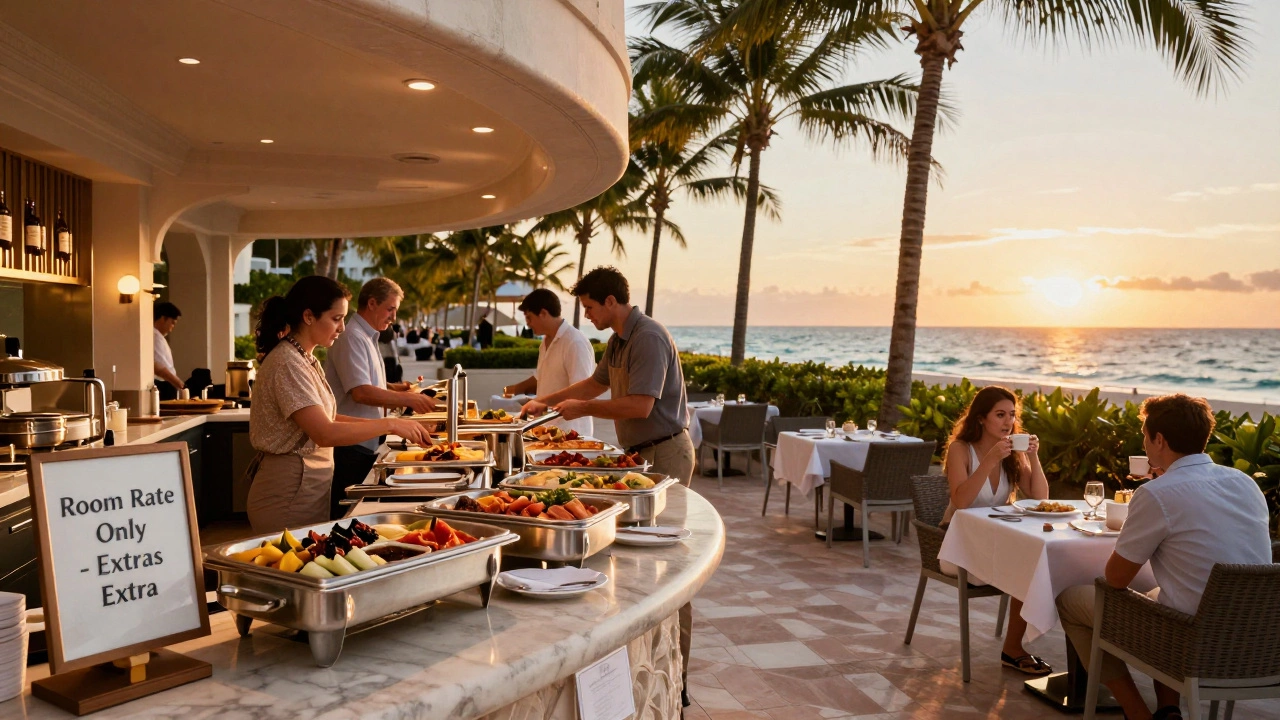
Think about it: if you run a resort in Florida, your biggest costs are land, staff, food, and maintenance. If you charge a flat rate, you’re locking in your revenue. But if you charge a base room rate and then let guests spend extra on drinks, spa services, and excursions, you’re turning your resort into a revenue engine. That’s why U.S. resorts push upsells so hard.
A 2023 study by the American Hotel & Lodging Association found that U.S. resort guests spent an average of $87 per day on extras - drinks, room service, spa treatments, and guided tours. That’s nearly as much as the average nightly room rate. Resorts know this. They design their spaces to make spending easy: bars at every turn, menus with premium pricing, and staff trained to suggest add-ons. It’s not greed - it’s economics.
In contrast, Caribbean all-inclusives operate on volume. They buy food and drinks in bulk, hire staff for fixed shifts, and plan activities around predictable demand. Their profit comes from high occupancy, not individual spending. They don’t need guests to spend more - they already priced in everything.
Why Americans Don’t Want It
It’s not that Americans can’t handle all-inclusive. Many do - and love it - when they travel abroad. But back home? There’s a cultural resistance. We don’t like being told what we can or can’t do on vacation. We want choice. We want to decide whether we want lobster for dinner or a burger from the food truck down the street. We want to skip the pool party and stay in with a movie. We want to pay for what we use.
This isn’t just about money - it’s about autonomy. Americans grew up with the idea that value means control. A $200 hotel room that lets you skip the $12 cocktail and eat at a local diner feels like a better deal than a $300 all-inclusive where you’re forced into a buffet at 7 p.m. Even if the buffet is better.
There’s also the perception problem. All-inclusives in the U.S. are often tied to budget chains or timeshare pitches. People associate them with overcrowded resorts, low-quality food, and pushy sales reps. That stigma sticks. Meanwhile, in places like Mexico, all-inclusive resorts are marketed as luxury - think 24/7 premium bars, private beach cabanas, and chef-led dining experiences.
The One Exception: Niche All-Inclusive in the U.S.
There are exceptions. A few high-end properties in the U.S. have tried all-inclusive models - and they work, but only for a specific crowd.
- Amangiri in Utah offers a full-service package that includes meals, guided hikes, yoga, and spa treatments. It costs $3,000+ per night. Guests don’t mind - they’re paying for privacy, not volume.
- The Lodge at Woodloch in Pennsylvania is a wellness resort that includes all meals, fitness classes, and treatments in its rate. It’s popular with couples and retirees who want structure.
- Alila Resorts in California and Hawaii have experimented with “planned experiences” packages that bundle activities, meals, and transportation. They sell out - but only because they’re marketed as curated escapes, not bundles.
These aren’t mass-market all-inclusives. They’re boutique experiences for people who value convenience over cost. And they prove one thing: Americans will pay for all-inclusive - if it feels exclusive, not obligatory.
The Real Reason: Infrastructure and Expectations
There’s another layer: infrastructure. In places like the Dominican Republic, resorts are often the only game in town. There’s no local restaurant scene to compete with. So the resort becomes the entire experience. In the U.S., resorts sit in the middle of cities, towns, and food cultures. Why would you pay $400 a night for an all-inclusive when you can walk five minutes to a Michelin-starred restaurant or a craft brewery?
Also, U.S. labor laws make all-inclusive harder to run. Tipping is expected. Staff are paid hourly. If you bundle everything into one price, you’re either cutting wages or raising rates so high that no one buys it. In contrast, in countries with lower labor costs and no tipping culture, resorts can afford to include gratuities in the price.

What Americans Actually Want
Here’s the truth: Americans don’t hate all-inclusive. They hate being forced into it. What they really want is predictable pricing - not bundled everything.
Look at how vacation rentals exploded in the U.S. Airbnb, Vrbo, and similar platforms succeeded because they gave people control: choose your kitchen, your schedule, your cleaning fee. No hidden charges. No mandatory activities. Just a clear price and total freedom.
That’s the American dream: know what you’re paying for, and choose what you want. An all-inclusive resort that says, “Here’s your base rate. Add on drinks, spa, excursions - you decide” - that would work. But one that says, “Pay $1,000 and eat what we serve at 6 p.m.”? That’s not freedom. That’s a cafeteria.
Will America Ever Go All-Inclusive?
Maybe. But not the way the Caribbean does it. The future of U.S. vacations isn’t about bundling everything. It’s about bundling the right things - and letting guests opt out.
Imagine a resort that offers:
- A base room rate
- An optional meal plan (breakfast, lunch, dinner - choose one or all)
- Unlimited non-alcoholic drinks
- Free Wi-Fi, parking, and fitness classes
- Pay-as-you-go for alcohol, spa, and excursions
That’s not all-inclusive. It’s smart-inclusive. And it’s the version America might actually adopt.
Some luxury brands are already testing this. The Four Seasons in Maui offers a “Dining Credit” - $150 per night you can use at any on-site restaurant. No restrictions. No forced menus. That’s the future: transparency, choice, and flexibility - not a one-size-fits-all package.
So no, America won’t suddenly turn into Jamaica. But it’s quietly evolving. The next generation of travelers - younger, more budget-conscious, and less interested in rigid packages - will push for models that balance convenience with control. And when that happens, you won’t see a Caribbean-style all-inclusive. You’ll see something better: an American version.
Why don’t U.S. resorts offer all-inclusive like Mexico does?
U.S. resorts rely on variable revenue from extras like drinks, spa services, and excursions - which make up nearly as much as room rates. In contrast, Caribbean resorts use bulk purchasing and lower labor costs to offer fixed pricing. American guests also value choice and control over bundled experiences.
Are there any all-inclusive resorts in the U.S.?
Yes, but they’re rare and high-end. Examples include Amangiri in Utah, The Lodge at Woodloch in Pennsylvania, and Alila resorts in California and Hawaii. These focus on curated, luxury experiences rather than mass-market bundling.
Do Americans hate all-inclusive vacations?
Not at all - many love them when they travel abroad. The resistance is cultural: Americans associate all-inclusive with lack of freedom, poor quality, or timeshare pressure. They prefer paying only for what they use, not being locked into a fixed menu.
Is tipping a reason U.S. resorts avoid all-inclusive?
Yes. In countries with all-inclusive models, tipping isn’t expected, and staff are paid fixed wages. In the U.S., tipping is required by law in many cases, and staff depend on it. Bundling tips into one price would either force guests to pay more or cut staff income - both unpopular options.
Will all-inclusive ever become popular in the U.S.?
Not in the traditional sense. The future is hybrid: base rates with optional add-ons. Think Four Seasons’ dining credits or resorts that include breakfast and Wi-Fi but let you pay for alcohol and spa. This gives control - which is what Americans really want.